
Industrial facilities are often challenged to increase production. Capacity constraints are almost always tied to one or more bottlenecks, or restrictions that limit flow, efficiency or reliability.
Debottlenecking addresses these constraints directly—and it’s a critical practice across refining, petrochemical and other industrial facilities. Here’s how to identify industrial bottlenecks, optimize your facility and minimize costly downtime.
Common Sources of Bottlenecks in Industrial Facilities
Experienced process engineers recognize that bottlenecks commonly originate in several areas, including:
- Equipment capacity constraints
- Hydraulic restrictions
- Process control limitations
- Utility system constraints
- Regulatory or safety margin creep
The Debottlenecking Process: How Engineers Identify the Real Constraint
A structured, six-step debottlenecking process ensures interventions target root causes rather than symptoms, reducing the risk of recurring issues.
Step 1: Baseline Data Collection
The first step is to gather actual and design performance metrics across your system. By quantifying throughput, energy use and equipment efficiency, engineers can identify where capacity is being lost and prioritize investigation.
Step 2: Process Flow Mapping
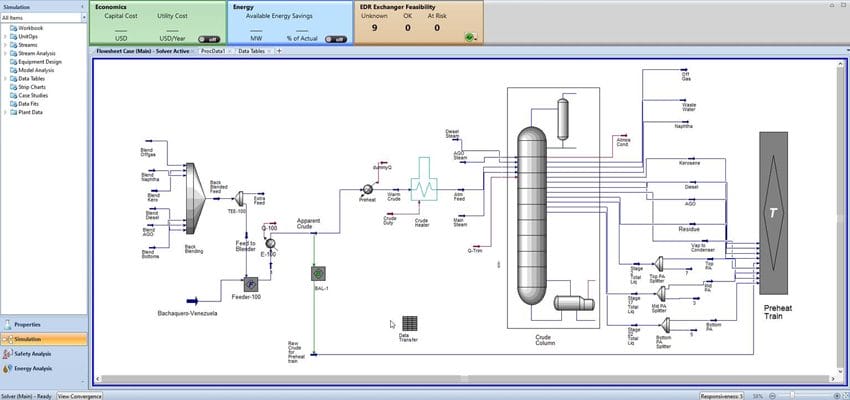
Next, material and energy flows are traced through your facility. This mapping highlights points of restriction, heat transfer inefficiencies and areas where pressure or flow drops occur. The goal of this step is to create a complete picture of system operation, providing a foundation for deeper analysis. Process simulation software, such as HYSYS or ProMax, is often used to create a heat material balance.
Step 3: Root Cause Analysis
High pressure drops, low conversion rates or inconsistent outputs may appear to be problems, but they’re often symptoms.
Root cause analysis distinguishes these from the underlying constraint, whether that’s an equipment limitation, a process imbalance or an operational practice. An accurate diagnosis is essential for a successful debottlenecking project.
Step 4: Constraint Ranking
Engineers will evaluate the capacity of each system component and compare it with the project’s goals to determine the constraints governing system throughput.
Step 5: Solution Development
Solutions are then developed to address the identified constraints. These can include operational adjustments like revised maintenance schedules or setpoints, minor equipment modifications or, when necessary, major capital installations.
In some cases, advanced modeling tools, such as computational fluid dynamics (CFD) modeling, may be used to evaluate proposed solutions and predict system behavior under new conditions.
Step 6: Implementation
Finally, engineering is initiated to implement the chosen solution. This is typically done through a stage-gate process that progressively refines the total installed cost estimate (TIC) to ensure the project meets its financial goals.
When Is a Debottlenecking Project the Right Approach?
Facilities turn to debottlenecking to meet increased throughput targets, and the cause isn’t clear—or to meet increased throughput targets. Repeated maintenance failures, regulatory shifts and feedstock changes can all trigger the need for the same approach.
Unlike greenfield design, debottlenecking maximizes the performance of existing assets rather than replacing them.
Effective debottlenecking demands rigorous diagnosis before anyone touches the equipment. JEPCO’s experienced process engineers will give the attention required to address your system’s constraints to minimize costly downtime.
Skipping straight to modifications without identifying all constraints ranks among the most common—and costly—mistakes in industrial process improvement.
Related Projects
We performed extensive Hysys modeling in order to debottleneck a crude unit for a Gulf Coast refiner to gain an additional 10,000 barrels per day.
FAQs
What is debottlenecking in process engineering?
Debottlenecking is the systematic identification and resolution of constraints that limit throughput, efficiency or reliability in a process system. While general optimization improves overall performance, the debottlenecking definition focuses on the single most limiting factor at any given time.
In process engineering, a bottleneck has a more precise meaning: it’s the point in the system that governs the maximum achievable capacity under current operating conditions.
How does debottlenecking play a role in refinery and petrochemical applications?
Refineries and petrochemical plants are highly interconnected, so a constraint in one unit often spreads across multiple systems.
Common debottlenecking refinery applications include:
- Feed preheat train limitations
- Fractionation column flooding
- Catalyst bed pressure drop in hydrotreaters
Petrochemical plants may face issues like:
- Reaction yield constraints
- Heat integration limits
- Inadequate utility capacity
Successful debottlenecking in these environments requires close coordination between process engineering, mechanical, and instrumentation teams. Analytical tools such as computational fluid dynamics (CFD) modeling can enhance understanding of flow, heat transfer and reactor performance during a debottlenecking project.


